
Begin a Metcalfe Records Search
The Metcalfe PVA/qPublic entry is the natural first stop for a Metcalfe County property search. Each parcel card ties the situs address to ownership details. It also covers the mailing address, the account number, the parcel number, and legal-description shorthand. You will find land and improvement information there too. The tax district and sale references sit in the same place.
Search modes vary. The page offers address, owner, and parcel lookups. Try whichever mode fits what you already know about the property. The official Metcalfe PVA search page is shown below.
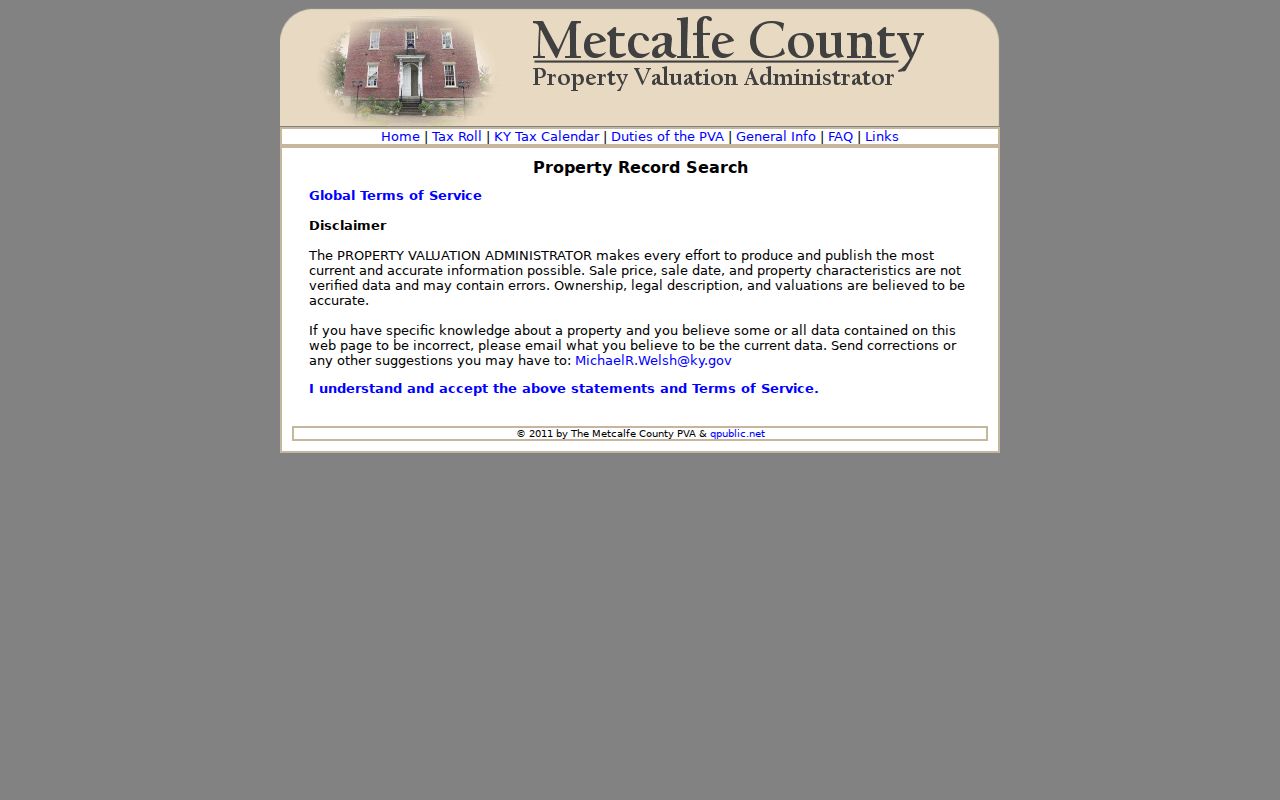
The portal is only the starting point. Deed, tax, and map references finish the record. Carry that parcel number to the other custodians. The County Clerk holds the instrument trail, while tax records settle billing and delinquency questions. Kentucky GeoNet offers broad map context, though the county publishes no Metcalfe-specific public parcel layer, and a property search is never a survey, appraisal, or title opinion.
- Search the PVA record by address, owner, or parcel.
- Use the owner and book/page in the clerk deed index.
- Compare assessment and tax records for the same parcel.
- Check map and plat context without treating tax lines as surveyed boundaries.
- Inspect at the counter or request copies when online access ends.
Where Metcalfe Property Records Live
Metcalfe County splits its property records by function. The County Clerk records conveyances and encumbrances. The PVA keeps the assessment rolls and owner-of-record parcel data, the sheriff collects current property tax, and the clerk handles the delinquent-tax certificate process.
Metcalfe qPublic Card Details
A Metcalfe parcel card displays a lot at once. Ownership appears with separate situs and mailing addresses. Account and parcel numbers sit beside land class, acreage, tax district, sale rows, and deed book/page, and other panels may add improvements, condition, utilities, zoning, subdivision, and lot size. Those details help separate a farm from a home, business tract, or utility parcel.
The mailing address is often the best same-name check. An owner may get notices in another town or state, so keep it distinct from the situs. Shorthand like “10A & HSE” is only a clue, since qPublic states that its description is not for legal documents.
One screen should never stand alone. Land and improvement panels cover separate assessment parts. Sale rows can carry dates, amounts, and book/page. The portal itself warns that sale price, date, and characteristics may be unverified. Save the parcel number and recording reference. Then pull the latest deed before drawing any ownership or price conclusion.
Metcalfe Deed Image Cutoffs
Metcalfe deed images have clear starting points. Deed images open at Book 35, February 2, 1933. Mortgage images start at Book 34 on February 15, 1963, Commissioner Deed Book 1 runs to December 20, 1884, and the clerk states that every plat is scanned.
Kentucky Land Records sells managed subscription access. Free public viewing still works at the clerk counter. When an image is missing online, ask for older indexes, deed books, or microfilm. Other series start later and unevenly. Wills and miscellaneous records begin in 1946, oil leases in 1991, corporations in 2001, county orders in 2007, and fiscal court minutes in 2008. That patchwork signals when to switch channels. Request a paper, microfilm, or vault volume instead.
Three Metcalfe Search Keys
An address points to a place. An owner name points to a party. A parcel number points to a tax-map unit. Begin with what you know, then record all three once they line up. This crosswalk cuts down errors from rural road variants, trusts, estates, initials, and postal place names.
Keep the PVA parcel number formatted exactly, zeros, hyphens, decimals, letters and all. A deed book/page is a separate clerk reference. Never substitute one for the other.
Owner searches need extra care when title sits in a trust, estate, or business, so try initials, full given names, prior names, and the entity name exactly as recorded. The Kentucky Secretary of State business search can identify an entity, but it does not replace a deed. For an old rural tract, adjoining owners and legal-description clues may beat a modern address.
Edmonton and County Records
Edmonton serves as the county seat and the only incorporated city. Ownership, deeds, assessment, and county taxes stay with the county. City records cover a different layer. Address assignment, permits, zoning, utilities, and code enforcement belong to the city.
Edmonton's code gives the Building Inspector authority over official addresses. That step comes before principal-building permit or occupancy approval. A city address question may start at City Hall. But the parcel and title trail still lead to the PVA and County Clerk.
A postal Edmonton address does not prove city limits. Compare the current city line and the PVA tax district. Check the situs field, deed or plat, and the city's address record too. Cedar Hills, Oak Hill Subdivision, Wildwood Estates, Willow Shade Community 3, and Summermont Sub remain search leads. They hold only until an official parcel result and recorded plat confirm them.
Types of Metcalfe Property Records
Each record set answers a different question about land in Metcalfe County. Deeds show recorded conveyances. Mortgages and liens reveal claims or security interests against a parcel, PVA cards describe tax parcels and their assessed attributes, and plats, maps, and court files supply the location and litigation context that rounds out the picture.
| Record Type | What It Documents | Kept By | Access |
|---|---|---|---|
| Deeds | Ownership transfers and descriptions | County Clerk | Free counter; online subscription |
| Mortgages and liens | Recorded claims and releases | County Clerk | Counter or KLR |
| Tax and assessment | Owner, land, value, district, tax status | PVA, sheriff, clerk | Portal and office |
| Plats and parcels | Lots, roads, and tax-map context | Clerk and GeoNet | All plats stated scanned |
| City address and code | Edmonton address assignment and code action | City of Edmonton | City request |
Ownership evidence lives in the latest conveyance and its connected releases. Current assessment data comes from the PVA card. The Metcalfe County deed records page covers the clerk's book runs and the grantor-grantee trail in far more detail.
Metcalfe Land Before 1860
Metcalfe County was formed in 1860 from Adair, Barren, Cumberland, Green, and Monroe counties. That matters for old records. A deed, tax entry, probate file, or court case from earlier decades may sit under a parent county's name instead. Fix the historic boundary first. Otherwise a "missing" Metcalfe book may simply be a record that was never filed here.
Two regional institutions help with that work. The Metcalfe County Public Library holds newspapers, yearbooks, family histories, cemetery material, and genealogy access. The Kentucky Department for Libraries and Archives offers county inventories and research-room support. Use them to gather old names and places. Then verify each clue in the official books, because those volumes are the record itself.
Start with the earliest Metcalfe deed. Read its prior reference, grantor, adjoining owners, and tract description. Test all five parent counties against the formation boundary. FamilySearch can supply a digital lead, and KDLA inventories show which government series survive. The cited volume and page remain the evidence to retrieve.
Courts Affect Metcalfe Land
Kentucky CourtNet can surface a case number, the parties, the court, status, events, and flags. Those flags may signal litigation tied to land. Foreclosure, quiet-title, lien, probate, and commissioner-sale matters can all arise. Each can explain a change in a deed chain. The summary is not the case file.
Request pleadings, orders, judgments, sale reports, or certified copies from the Metcalfe Circuit Clerk. A 2025 commissioner-sale notice cited a PVA Map ID. It also cited a deed book and page, the judgment, restrictions, and easements. Even so, a final transfer requires confirmation in both court and deed records.
Search by party or business name first. Narrow with jurisdiction, case number, and case type when known. Record the filing date, the status, and any event that points to land. Then request the local file. A docket summary may omit the legal description or an exhibit. A sale notice, a judgment, a sale report, and a commissioner deed each perform a different job.
Limits of Metcalfe Property Records
Public records can identify an owner of record. They can also show an assessment, a recorded deed, a lien, a plat, or a court case. They cannot do everything. Property records do not show every unrecorded agreement. They do not prove a line on the ground, guarantee market value, or establish clear title. The qPublic disclaimer also warns that sale details and characteristics may be unverified.
Lawful use. Metcalfe property records support due diligence, boundary research, estate work, and civic review. Do not use personal details to target or harass anyone.
Metcalfe Plats and Parcel Context
Recorded plats and tax maps serve different jobs. The County Clerk states that all plats are scanned. A plat can show lots, blocks, streets, dimensions, dedications, and survey references for a recorded division, while Kentucky GeoNet supplies statewide map context. The county offers no public Metcalfe parcel-service endpoint and no local adjacent-parcel tool.
Begin with the parcel number from qPublic. Compare its road, acreage, tax district, and short description with any deed or plat reference. Roads and landmarks orient a tract. They do not set a legal line. The Edmonton-Metcalfe County Industrial Park map labels roads, utilities, businesses, city-limit context, and flood information near the northeastern edge of the city. Those labels help identify an area, but they cannot replace a recorded description or a field survey.
When no usable parcel layer appears, take the number to the PVA and ask for the current map or card. Take a subdivision or plat reference to the clerk. A licensed surveyor is the proper source whenever monuments, bearings, overlaps, or an actual boundary must be resolved.
Metcalfe Records Beyond Deeds
Land questions often cross into court and estate records. Kentucky CourtNet 3 accepts jurisdiction, case number, party, and business information. Its results can identify the case number, county, division, status, parties, events, and flags. The actual file stays with the Metcalfe Circuit Clerk. For foreclosure or quiet-title matters, request the complaint, lis pendens, judgment, and sale order. Also request the commissioner report and any public exhibits tied to the parcel.
An estate transfer may require a will, a probate file, a deed, and a death record. Each comes in sequence. The County Clerk holds wills and recorded deeds. The Circuit Clerk controls the local court files. A death certificate can explain why an estate search begins. The deed or court order shows how the land actually moved.
A company sometimes holds the parcel. The Kentucky Secretary of State Business Entity Search can identify the entity profile. Search the exact legal name from the card. Then return to the deed index with that spelling. Corporate status alone does not establish ownership of a tract.
Request Missing Metcalfe Records
Kentucky's Open Records Act, KRS 61.870 through 61.884, gives you a formal way to ask for a Metcalfe County record that is not online. Address the request to whichever office keeps the record. Identify the parcel, the parties, the document type, and a date range. County policies allow five working days for a determination, subject to exemptions and copy costs.
Each office has its own useful records. The PVA can supply a current property card and a map. It can also supply assessment history and the date ownership changed on the tax roll. The county clerk can pull an index entry, deed, plat, mortgage, release, lien, or tax certificate. Just give the book and page. The court clerk works from a CourtNet case number. Edmonton holds address-assignment, permit, zoning, inspection, code-enforcement, lien, and release records tied to the address.
Do not overlook mail and in-person service. Online deed access needs a subscription, but viewing at the public counter is free. Older books may call for staff help, microfilm, KDLA, FamilySearch, or local-history research. Write down the source date. Portals, fees, annual sale dates, and book coverage all shift over time.