
Start a Metcalfe Property Search
The Metcalfe PVA/qPublic entry is the practical first stop for a Metcalfe County property search. The county advertises owner-name searching, though the live search controls sit behind a bot shield. Address and parcel searches are worth testing in the current Schneider application too. A result bridges an everyday street address to the account and parcel identifiers used across other Metcalfe records.
- Try the situs address in qPublic, then shorten it if punctuation or a road suffix blocks the match.
- Open the card and copy the owner, mailing address, account, parcel number, and deed book/page.
- Carry the owner and recording reference into the County Clerk's deed index.
- Compare the parcel with tax and Kentucky GeoNet map information.
- Ask the custodian for an image or certified copy when the record itself matters.
Working in this order limits false matches. A name alone can point to several people, an estate, a trust, or a company. A road address may just follow a postal convention. Once the right card appears, the parcel number is the cleanest join.
Metcalfe qPublic Result Fields
A Metcalfe parcel card gives more than an owner line. It groups identification, value, land, improvement, and transfer clues in one place. It also carries a warning: sale price, sale date, and characteristics may be unverified, while ownership, legal description, and valuation are believed accurate.
| Ownership | Owner name and a separate mailing address |
|---|---|
| Location | Situs, tax district, subdivision, and zoning when supplied |
| Parcel keys | Parcel number, account number, and map reference |
| Land and buildings | Acreage, lot size, class, condition, utilities, and improvements |
| Transfer clues | Sale fields and deed book/page reference |
The official PVA search page provides the entry shown below.
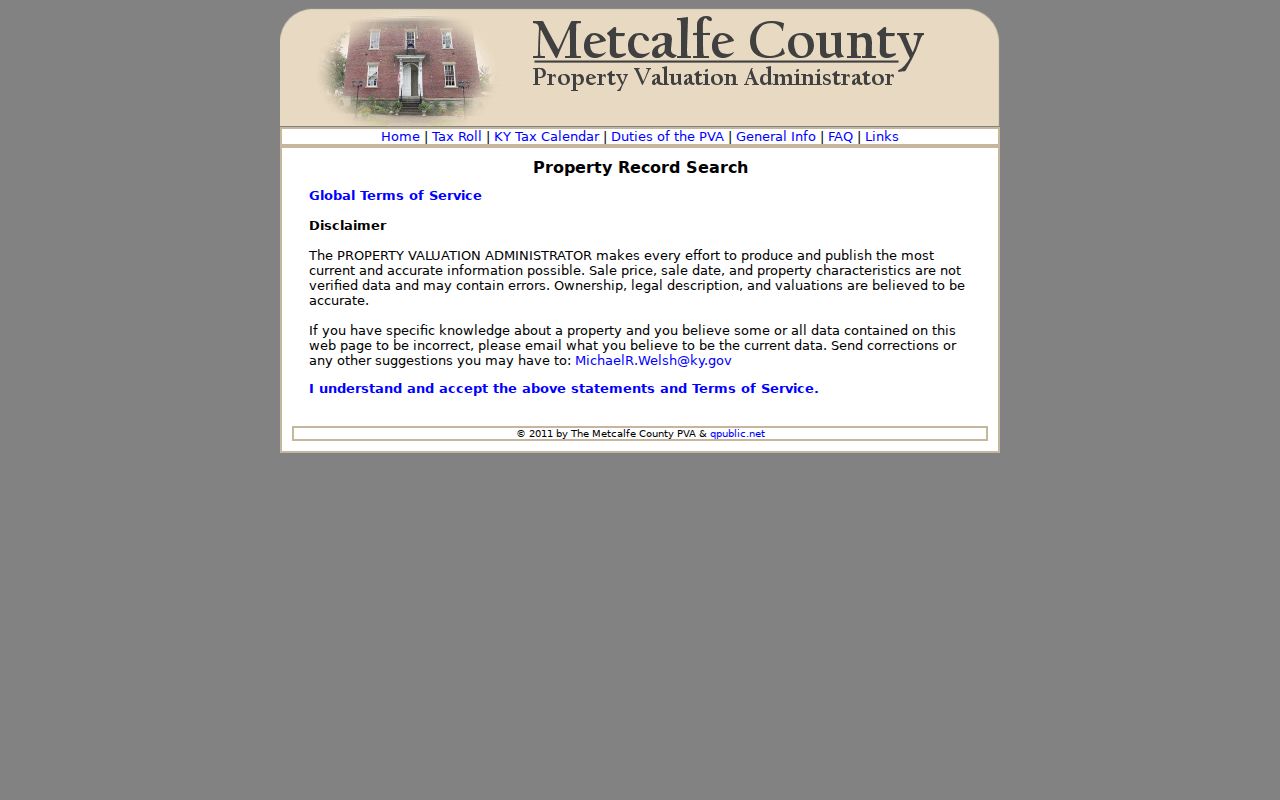
The entry screen confirms the correct county portal; parcel details still need matching to deed and tax references.
A short description is only a finding aid. One farm entry reads “10A & HSE,” and qPublic itself says parcel descriptions are not for legal documents. Pull the deed and recorded plat for legal wording. Tax-map boundaries are not a survey.
Metcalfe Addresses Need Labels
Sample cards show why an address needs a label before reuse. The situs locates the land. The owner mailing address routes notices. It may sit in Edmonton, another Kentucky town, or another state. It does not move the parcel. That distinction helps most when two owner results look nearly alike.
County-serving ZIP names add another layer. A postal place can cover a rural route far past an incorporated boundary. Check tax district and map context before calling land part of Edmonton.
Parcel Numbers Join Metcalfe Records
Metcalfe reports include segmented parcel numbers and separate account numbers. Keep the leading zeros, hyphens, decimal suffixes, and letters intact. A sample telecommunications parcel shows how a suffix works. It can separate a special parcel from the surrounding tract.
The parcel number is the best exact join once the property is known. Compare it across assessment data and map information. It also appears in delinquent-tax lists and court notices quoting a PVA Map ID. An account number works inside PVA records. It never replaces a clerk book/page or instrument reference.
Metcalfe Land and Building Panels
Metcalfe reports carry acreage and lot-square-foot fields, land class, condition, utilities, zoning or subdivision labels where populated, and improvement details. These fields test whether a result is the expected farm, house, commercial tract, or utility site. A blank field is not proof a feature is absent.
Compare stable traits instead. Road, acreage, building type, mailing address, and deed reference together make a stronger match than any single value. For a purchase or boundary question, verify the material details with the custodian and the recorded instruments.
Metcalfe Sale Rows Need Proof
One qPublic sample shows a zero-dollar sale row. That can mark a non-market transfer, missing consideration, or an unverified reporting artifact. It does not prove the land lacked value. The portal's own disclaimer treats sale data as potentially unverified.
Follow the book/page to the deed. The deed may name the parties, consideration language, legal description, reservations, and related instruments. A recent owner line can lag behind a recorded transfer. The county publishes no update interval. Ask the PVA whether a cited recording has reached the roll.
Choose a Metcalfe Search Key
Each key answers a different first question. An address works best when the land is known but the owner is not. An owner name may reveal several parcels. Yet spelling, initials, married names, estates, trustees, and business forms all require care. A parcel number is exact, but it usually must be discovered first.
| Search Key | Best For | Where It Works | Watch Out |
|---|---|---|---|
| Address | One known site | PVA and map | Postal place, suffix, or road variants |
| Owner name | Parcels tied to one party | PVA and clerk | Initials, estates, trusts, and same names |
| Parcel number | An exact tax parcel | PVA, tax, and maps | Formatting may differ |
Not a title search. A Metcalfe County property search finds public clues. It does not guarantee clear title or replace a survey, attorney, or title professional.
Move from Parcel to Deed
The parcel card's owner and book/page form a bridge to the Metcalfe County Clerk. The clerk records deeds, mortgages, leases, liens, lis pendens, wills, plats, and tax certificates. Kentucky Land Records offers managed subscription access, and inspection at the clerk counter is free.
Search the owner as grantee to find the acquisition deed. Confirm its description and recording reference. For a full conveyance trail, the Metcalfe County deed records guide explains the grantor-grantee path. It also covers the older books.
Fallbacks for Metcalfe Searches
Not every record sits in one free portal. The live qPublic controls sit behind a bot shield. Kentucky Land Records requires a subscription. Kentucky GeoNet offers no confirmed Metcalfe-specific parcel layer or adjacent-selection tools.
Call or visit the PVA for roll questions. Inspect clerk indexes at the counter, or send a focused request naming the owner, parcel, approximate date, and record type. Kentucky's Open Records Act supplies a request path, with a determination generally due within five working days, subject to exemptions and copy costs.
Historic Metcalfe Property Search
Metcalfe County was formed in 1860. Its land came from Adair, Barren, Cumberland, Green, and Monroe counties. So an old tract's deed chain may start in a parent county before Metcalfe existed. Online images carry book-specific dates. Those dates are not the start of all land records.
The Metcalfe County Public Library holds newspapers and yearbooks. Family histories, cemetery sources, and genealogy tools are available there for in-library use. The Kentucky Department for Libraries and Archives adds inventories and a research room. These sources surface old names and places. Deeds and tax books supply the record evidence behind them.
Search Metcalfe Court References
A Metcalfe County parcel can surface in foreclosure, quiet-title, lien, probate, or commissioner-sale litigation. Kentucky CourtNet 3 searches by jurisdiction, case number, party, or business. Results give an identifier and a summary. The Circuit Clerk keeps the actual file. Search the owner's exact name within a likely date range. Then compare any legal description or PVA Map ID in the pleadings against qPublic.
A 2025 commissioner-sale notice shows how these threads join. It listed a map ID, a deed book and page, judgment details, restrictions, and easements. Treat a notice as a discovery tool, not proof that a transfer closed. Read the court order and commissioner report. Then confirm whether a commissioner deed was recorded in the County Clerk's deed records.
Ask for a Metcalfe Record
When a portal blocks access or lacks a field, send a narrow request. For the PVA, identify the address or parcel. Ask for the card, the current owner field, assessment history, and the date of the last ownership update. For the clerk, give party names and an approximate year. Include the document type and any book or page. Kentucky's Open Records Act provides the formal route, subject to exemptions and copy costs.
Keep a source log. Record the office, access date, parcel number, account, and recording reference. That log pays off when a deed appears before the tax roll changes. It also matters when mailing and situs addresses differ. It also keeps official facts separate from inferences drawn by comparing sources.
Metcalfe Search Terms That Work
Names in the clerk and PVA systems may carry initials, married names, estate labels, and trustees. Company forms also appear. Try the exact record spelling first. Then test the surname with initials or the entity's legal name. Before treating a hit as the same owner of record, match it by mailing address, acreage, road, and account. Legal-description clues help confirm it too.
For an address, drop punctuation from the road name and compare rural ZIP names. For a parcel, keep every zero, hyphen, suffix, and letter in the parcel number. For a deed, search both party roles around the estimated transfer year. Document each small change so a later user can reproduce the property search.