
Identify a Metcalfe Property Owner
The Metcalfe PVA roll and the Metcalfe County Clerk's newest deed together answer the ownership question. The PVA card links a situs to an owner name. It also carries the parcel key. The deed adds the recorded grantee and the legal description. Aerial images and postal city names can't replace those record links.
- Search the known situs or full parcel number in the Metcalfe PVA/qPublic system.
- Copy the Ownership name, parcel/account, mailing address, legal shorthand, sale date, and deed book/page.
- Search that name as grantee in Kentucky Land Records or ask the County Clerk for the newest deed.
- Match the parcel, legal description, grantor, grantee, date, and cited book/page before drawing a conclusion.
- If a business appears as grantee, use Kentucky's entity search to identify the official filing, without treating an officer as the landowner.
An assessment roll can lag behind a fresh deed. Metcalfe sources publish no fixed number of days for the PVA update. Note the date on the card and the deed, then ask the PVA whether that transfer has reached the roll.
Read Metcalfe's Ownership Field
The official Metcalfe PVA/qPublic search is the public web entry for parcel assessment records. A live Cloudflare screen guards its search controls. Even so, qPublic cards carry an "Ownership" field along with mailing and situs addresses, parcel and account numbers, acreage, land class, tax rate, and sale book and page references.
Mind the qPublic disclaimer. Ownership, legal description, and valuation are believed accurate. Sale price, sale date, and property characteristics may contain errors. A displayed owner is a starting result, not a certified title opinion.
That official link opens the Metcalfe County owner lookup.
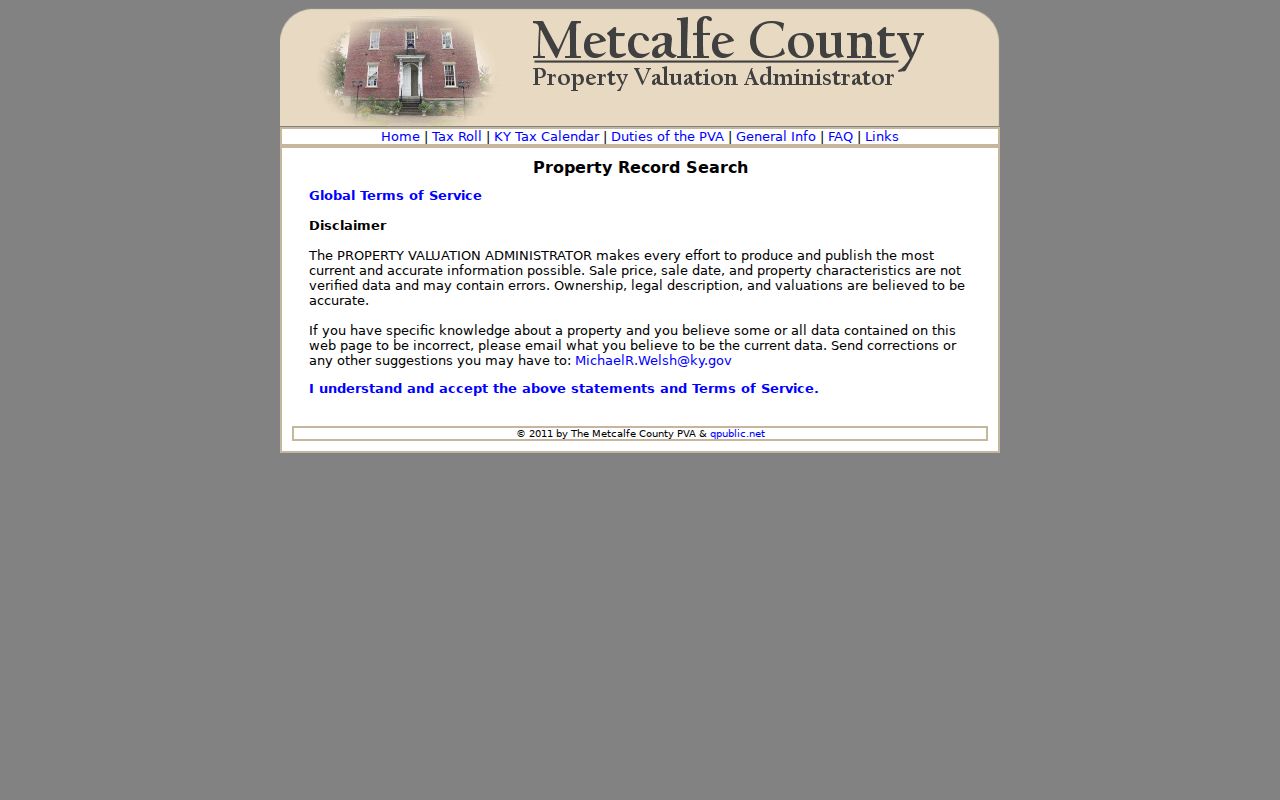
If the live form blocks your access, call the PVA. Give the situs and parcel number rather than trusting an old cached result.
Separate Metcalfe Mailing and Situs
The situs is the land's physical location. The mailing address is where the PVA sends correspondence. Official Metcalfe sample cards show mail going to another Kentucky town or another state. That split helps with same-name checks, but it never shows who occupies the parcel or where the owner lives day to day. Keep both addresses in their own fields. Rural roads also carry suffix and spelling variants. If the street fails, use the full parcel identifier. Compare acreage and legal shorthand as a cross-check. A ZIP name alone cannot decide whether land lies within Edmonton's incorporated limit.
Note: The mailing address is often the best same-name clue, but it never replaces the parcel and deed description.
Compare Metcalfe Ownership Sources
Each official source answers a different part of the ownership question. The assessment roll gives the current owner of record. The deed gives the recorded conveyance. A parcel map only orients the tract, and entity filings can clarify a business name without ever altering the deed's grantee.
| Ownership source | What it contributes | Access route |
|---|---|---|
| Metcalfe PVA roll | Owner of record, mailing/situs, parcel, snapshot date | qPublic web entry, phone, or PVA request |
| County Clerk deed | Recorded grantee, legal description, date, and book/page | Free counter viewing, KLR subscription, mail, or records request |
| Kentucky entity filing | Organization record, officers, and registered agent | Free Secretary of State business search |
| GeoNet map | Parcel position and identifier if the county layer loads | Statewide viewer; Metcalfe parcel tools remain unconfirmed |
Public indexes and documents may be viewed at the clerk's office without an online subscription. Kentucky Land Records is the managed subscription channel. The clerk also accepts mailed recording and requests. Its open-records policy provides a written route for records no portal carries.
Confirm Metcalfe Owners by Deed
Carry the PVA name to the Metcalfe County Clerk. Search the owner as grantee. Pull the newest deed matching the tract. Older instruments may omit a street address, so match acreage, adjoining owners, lot and block, or metes-and-bounds language instead. The online deed images start with Deed Book 35, dated February 2, 1933. That date is an image cutoff, not the start of county land records.
Counter inspection is free. KLR supplies subscription access online. The clerk sits at 201 North Main Street, Edmonton, open weekdays from 8 a.m. to 4 p.m. and Saturdays from 8 a.m. to noon. Phone, mail, and an open-records request work as fallbacks. The Kentucky Open Records Act policy allows five working days for a determination, subject to exemptions and copy costs.
Trace Metcalfe Entity Ownership
A PVA owner field may name an LLC, corporation, trust, or estate; preserve the name exactly as written. For a business, search the Kentucky Secretary of State entity database by organization name or ID. Filings can show status, officers, or a registered agent. None of those people owns the land personally; the deed may vest title in the entity itself.
Trusts and estates need a different check. Read the deed's vesting text and signatures. Then look in the clerk and court records for a will, affidavit of descent, probate transfer, or later conveyance. A death certificate can support identity research. It is not a land instrument. The latest deed, with any valid later court order or recorded affidavit, controls the paper trail.
- Owner of record
- The name carried on the current assessment roll at the date viewed.
- Grantee
- The person or entity receiving an interest in a recorded deed.
- Title
- The legal ownership interest, which cannot be proved by one tax-screen field.
- Situs
- The parcel's physical location, distinct from the owner's mailing address.
Do Not Mistake Tax Sale Status
Reading a Metcalfe delinquent-tax list takes care. It flags an unpaid claim and a certificate process, nothing more. The owner named there has not automatically lost title. The same caution applies to a commissioner-sale notice. It advertises a court-directed sale but proves neither a closing nor a recording. Before changing any owner-of-record conclusion, pull the CourtNet case, the Circuit Clerk file, and the commissioner report. Pull any deed recorded afterward as well.
Sale rows deserve a second look too. One qPublic sample pairs a zero-dollar sale price with a deed book and page. The PVA warns that sale fields may go unverified. Open the cited deed itself. That instrument tells you whether the transfer was a family conveyance, an estate step, or a corrective act. It could also be some other deed type.
Ask Metcalfe Records Staff
Portal trouble should change the channel, not the proof standard. Call PVA Michael Welsh at 270-432-3162 with the address and parcel number in hand. Ask whether a newly cited deed has reached the tax roll. Request the current Ownership field and report date. Also request situs, mailing address, assessed components, and the latest sale reference. Correction material goes to MichaelR.Welsh@ky.gov.
For the recorded owner of record, contact County Clerk Shannon Fields at 270-432-4821. Counter and terminal viewing is free at 201 North Main Street in Edmonton. The office accepts mail requests as well. Kentucky Land Records offers subscription web access to deed records. A precise written request should seek the grantor-grantee index and the newest deed. It should also seek the legal description and the cited prior instrument. Include any related liens, easements, restrictions, or releases.
The clerk follows the local Kentucky Open Records Act policy. The office issues a determination within five working days, weekends and holidays excluded, subject to exemptions. Copies, postage, and some commercial uses may carry charges. Ask for an estimate before copies are made.
Rank Metcalfe Ownership Evidence
Rank your sources by directness. The recorded deed is strongest for a transfer and the legal description. The PVA card wins on the current assessment-roll name and parcel administration. A recorded plat backs up lot layout. GeoNet adds broad location context when its county layer loads. Court orders and commissioner deeds explain ownership changes. These are changes that never passed through an ordinary private sale.
Conflicts are clues, not verdicts. A deed naming one grantee may differ from the tax roll. That calls for comparing recording and report dates. Neither should be dismissed too quickly. When the street address and legal description seem to point at different tracts, work from the parcel number. Use the acreage, adjoining tracts, and plat too. An estate or trust may sit between two deeds. Inspect that instrument rather than skipping the link.
This ranking also keeps a paid commercial summary from outranking the public record it copied. Official property records can still hold errors. But they name the custodian who can explain or correct any field.
Limits of Metcalfe Owner Records
An owner-of-record name has limits. It does not establish who occupies the land, settle a boundary, reveal every easement, or prove clear title. The tax roll can lag a recent transfer, a GIS copy lags further still, and the short PVA description should never anchor a legal document. Anyone buying, selling, resolving an estate, or untangling an access dispute should gather the complete deed trail. Qualified help is worth it where the stakes run high.
Use owner records lawfully. Metcalfe ownership data supports due diligence, estate work, boundary research, and civic review; never use it to target, stalk, or harass anyone.
Kentucky Safe at Home shields a participant's address in certain public systems. Current state compliance material, though, notes limits involving real-estate holdings. Never try to evade an address-confidentiality program. Ask the custodian for the public, redacted record and respect each lawful withholding.